
What is a CRO (Chief Revenue Officer)?
Summary:
The Chief Revenue Officer (CRO) is not just another executive title—it’s the linchpin that unites sales, marketing, and customer success under one coordinated growth strategy. In this article, Krista explains what a CRO does, how the role differs from a CFO or COO, and why aligning all revenue-generating functions can dramatically increase close rates, customer retention, and overall profitability.
Transcription: Is a CRO (Chief Revenue Officer) like a CFO?
I get that question a lot.
This is CRO like a CFO, and the answer is not at all.
A CRO, or a Chief Revenue Officer, is responsible for building your revenue operations.
A CRO will coordinate your sales, your marketing, and your customer success or customer retention strategies.
So, everything that has to do with bringing in that top-line revenue.
A CFO or Chief Financial officer is more about planning out your financial strategy. Managing the financials of the organization and really helping you to be profitable.
Where you may see some overlap is between a CRO and a COO, depending on how the organization is structured.
I think that every organization should have someone who oversees and coordinates its revenue generation efforts.
What you see often is that “sales” is in one silo, “marketing” is in another, and “customer retention” is in another.
Where all the studies show that if you have coordinated efforts, your close rates are going to go up because sales and marketing are communicating better.
You’re going to have better customer retention, and you’re even going to have improved ROI, and you’re not gonna be leaving money on the table. That’s pretty good.
By the Numbers
According to Fit Small Business:
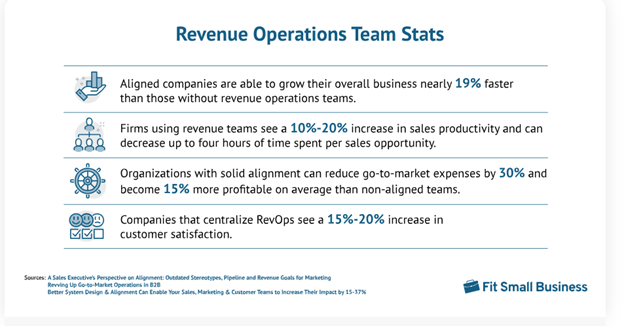
- You can enjoy 19% faster growth than those companies without revenue operations.
Here are some other great stats as well:
-
67% improvement in closing deals because sales and marketing are aligned (Hubspot).
-
36% increase in customer retention rates when sales, marketing, and customer success are properly aligned (Hubspot).
-
28% in profitability when people, processes, and technology were aligned (Forrester).
The value of aligning teams with the overall strategy is clear. But not everyone is doing it, which means a lot of money is left on the table.
Additional Source material from Sonar Software: